




The 4 C's: Carat, Cut, Clarity and Colour
The 4 C’s of diamonds stand for carat, cut, clarity, and colour. These four characteristics together determine the quality and value of a diamond.
Carat refers to the weight of a diamond. The higher the carat, the heavier and often more valuable the diamond is. One carat equals 0.2 grams.
Cut refers to the quality of the diamond’s cut. It determines how well the diamond reflects light and how much it sparkles. A well-cut diamond has more brilliance and shine.
Clarity refers to the purity of the diamond. It indicates the presence of inclusions or small imperfections. The clearer the diamond, the higher its quality.
Colour refers to the color of the diamond. The most valuable diamonds are colorless, while diamonds with a yellow tint are usually less valuable.
At Aurore Jewelry, we work with lab grown diamonds that are graded according to the same 4 C’s. This ensures quality and a conscious choice.
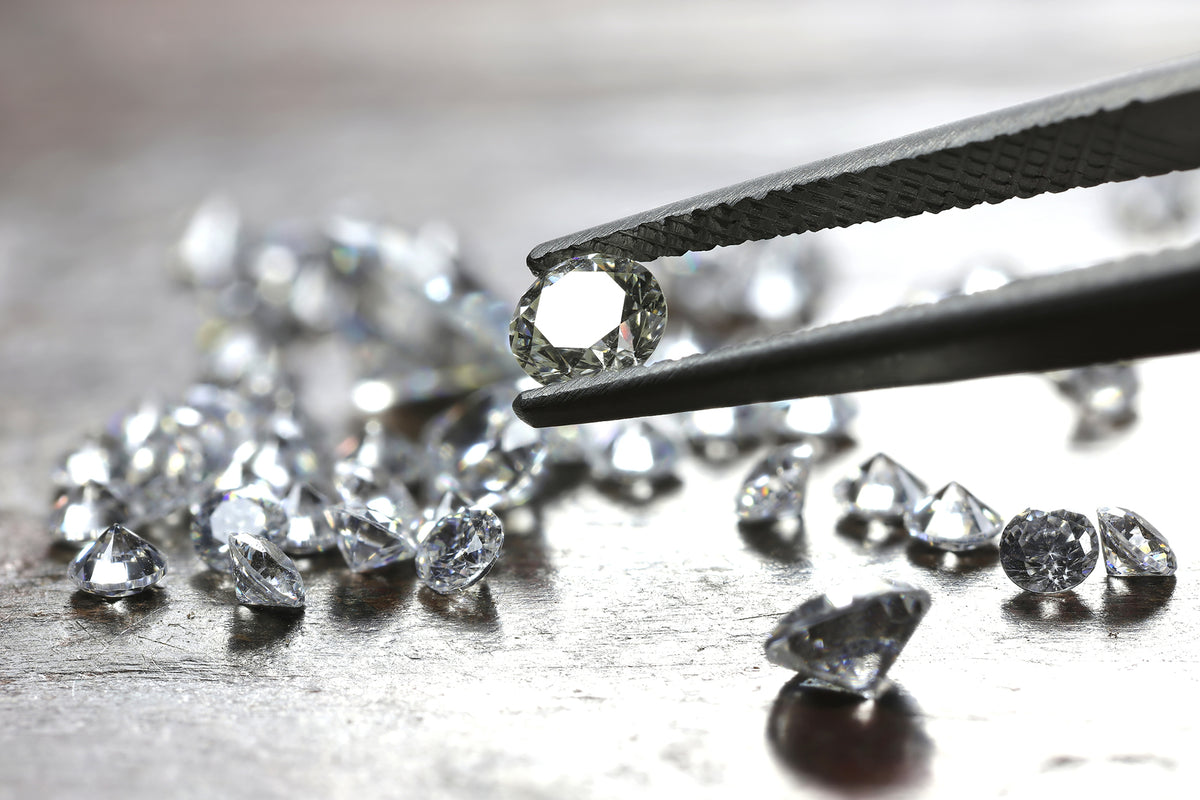
Diamonds under the microscope
Why are the 4Cs so important?
Diamonds grow - both in nature and in a laboratory - in a unique way. As a result, no two diamonds are identical. Even when two stones have the same carat weight, they can look completely different.
The 4 C's make it possible to assess every diamond fairly and objectively. This way, you know exactly which characteristics your diamond has and you can easily compare different diamonds with one another.
At Aurore, however, we look beyond just the numbers on a certificate. A diamond must not only be technically excellent, but above all, it must come to life the moment light hits it. That is why our experts carefully evaluate every diamond before it becomes part of one of our designs.
1. Cut (Slagings)
Cut is arguably the most important characteristic of a diamond. A well-cut stone appears larger, clearer, and more radiant. Furthermore, it is the only characteristic that can be influenced by human skill.
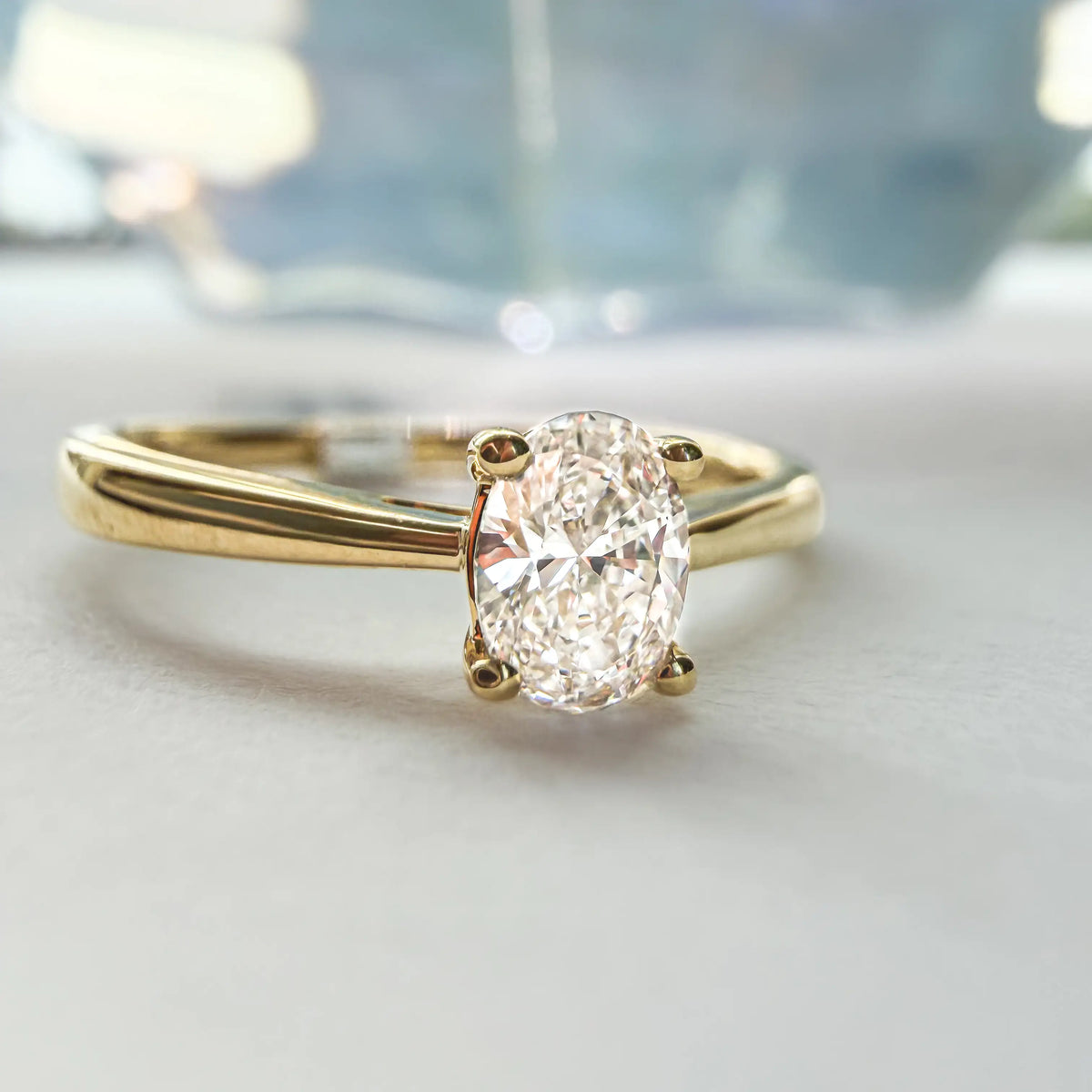
Incidentally, the cut says nothing about the shape of the diamond (round, princess, emerald, pear), but only about the balance between proportion, symmetry, and brilliance achieved by the diamond cutter. The closer this is to perfection, the more a diamond will sparkle. Essentially, the cut quality determines how effectively light entering the diamond is refracted within the stone and reflected back through the top of the diamond. A poorly cut stone is often too deep or too shallow, causing most of the light to escape and making the diamond appear dark with little sparkle. For this reason, we only use diamonds with a 'very good' cut or higher for Aurore jewelry.
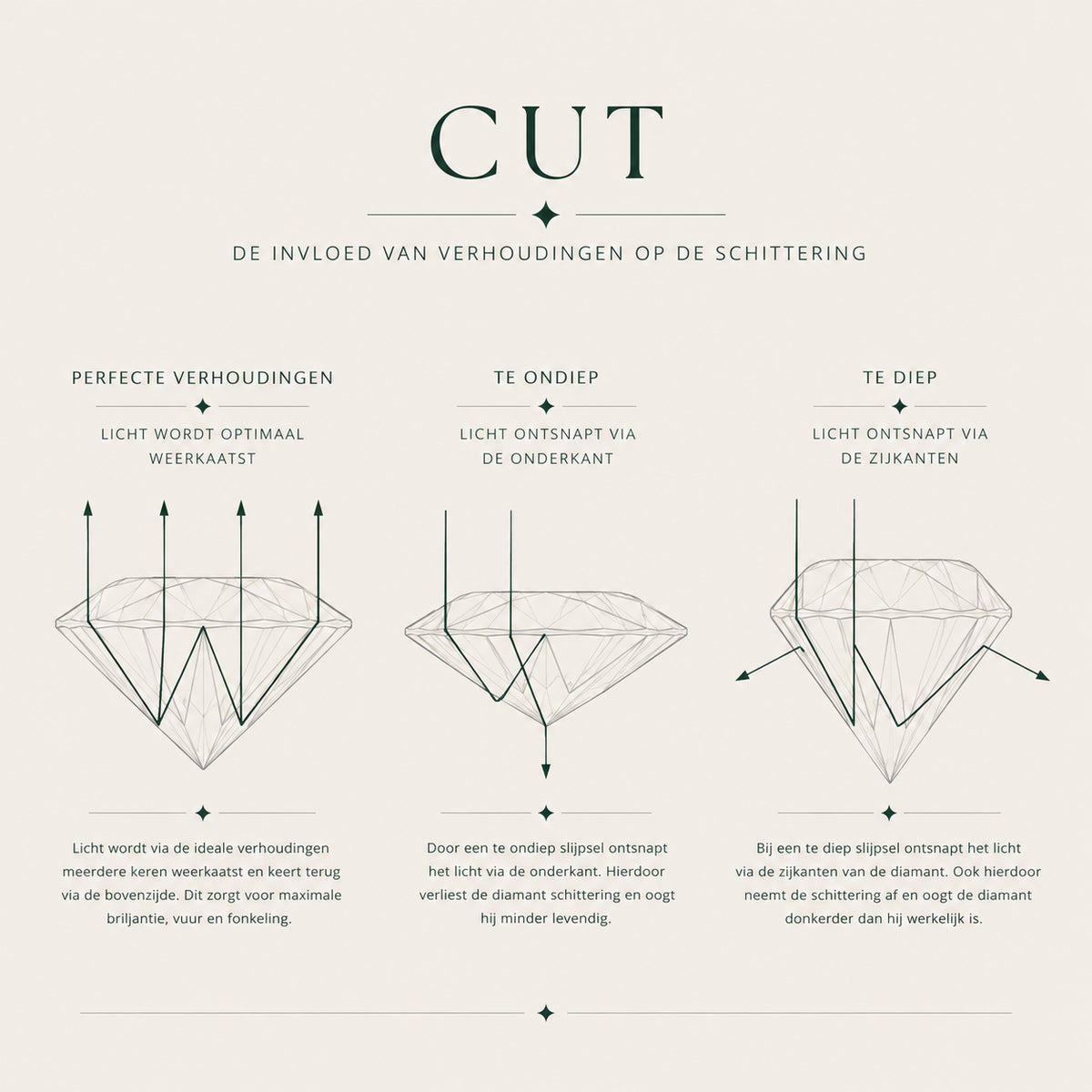
Diamond & light
The way light affects a diamond is often divided into the following three categories:
Reflection
Part of the light is reflected directly back by the top (table) of a diamond.
Dispersion
Shows how light travels inside the diamond and is reflected by the cut facets. The better the arrangement of the facets, the better the light is reflected back through the diamond.
Refraction
The light enters through the top of the diamond, is broken down into a rainbow of colors, and is then reflected back and forth by mirroring against the facets. When it leaves the crown of the diamond again, the colors remain separated, and your eye perceives a rainbow of colors. This is also called fire.
2. Colour
When you talk about diamond color, it has a different meaning for fancy colored diamonds than it does for white diamonds. In the latter case, it actually refers to the absence of color. Although diamonds often appear colorless, there are subtle differences in color. The less color a white diamond contains, the rarer and more valuable it is. Color is internationally graded on a scale from D (colorless) to Z (light yellow or light brown).
For our collection, we exclusively select high-quality lab-grown diamonds with a fresh, clear appearance. This ensures our jewelry retains its luxurious look, and the diamonds sparkle beautifully in combination with 18-karat recycled gold.

Gorgeous colors
Diamonds with less color allow more light to pass through, releasing more brilliance and fire. As read above, a diamond acts as a prism and reflects light as colorful flashes known as fire. Just as when looking through colored glass, a diamond with more color will act as a filter and therefore diminish the reflected spectacle of color, or fire. A diamond with a higher color grade, i.e., a whiter stone, exhibits more colorful fire.
We work exclusively with diamonds of F-color or higher.
3. Clarity
Clarity refers to the clearness of a diamond and the potential presence of inclusions. Almost all diamonds have some form of inclusions. These characteristics on the surface and inside the stone are inspected by gemologists who use 10x magnification to assign a clarity grade to the diamond. The number of imperfections, their position, and their size ultimately determine the grade. Diamonds with no or very few inclusions are considered extremely rare and are therefore very valuable.
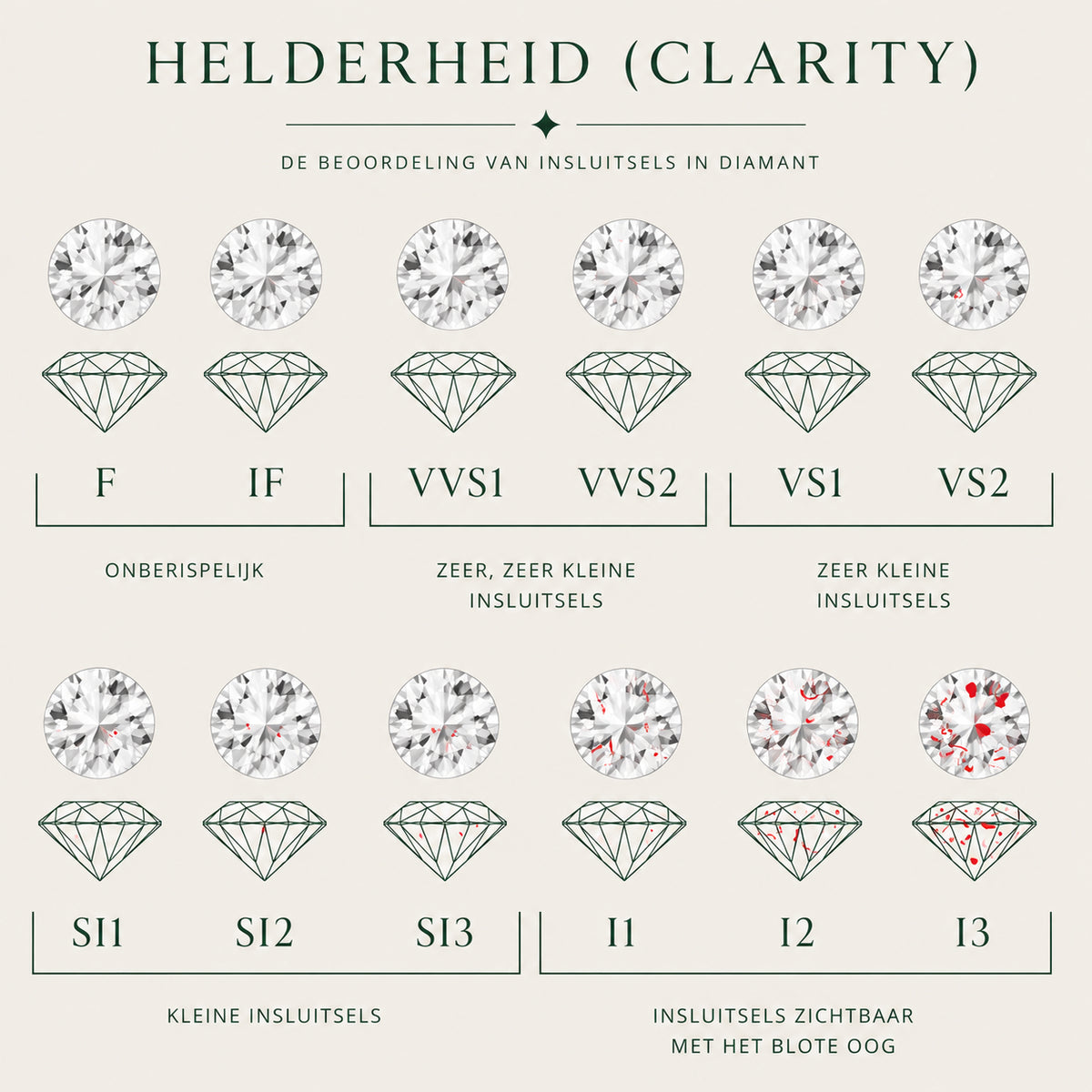
Which clarity do you want?
A large number of experts agree that clarity affects the appearance of a diamond the least, as long as it is eye-clean. This actually applies to all diamonds with an SI2 classification or higher. Diamonds graded lower usually exhibit imperfections that are easily noticeable to the naked eye. There are certain diamond shapes, such as emerald or baguette, where clarity is more important due to their mirrored facets.
For our jewelry, we use diamonds with a clarity of VS2 or higher.
4. Carat
Carat refers to the unit of weight for diamonds. In this context, 1 carat is equal to 200 milligrams, or 0.2 grams. When referring to diamond weight, the term 'points' is also often used. 1 point is equal to 0.01 carats, so 100 points equals 1 carat.
The word carat is derived from the word carob, referring to carob trees. Long ago, the seeds of these trees were used as counterweights for weighing diamonds, gemstones, and precious metals, as it was believed they had the same mass.
Bigger is better?
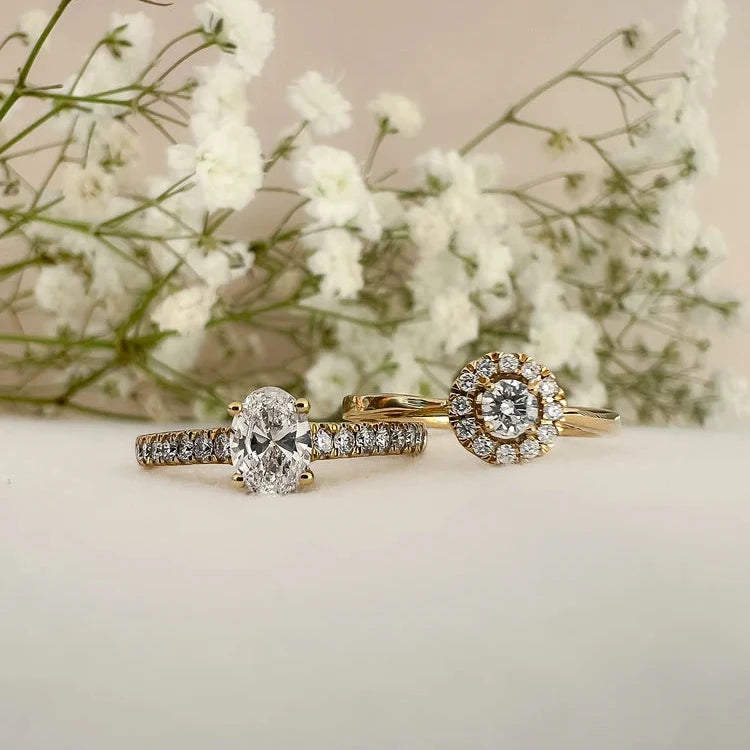
When selecting a diamond, people often look exclusively at the carat count. It is important to know that carat weight is not equal to the size of a diamond. Depending on, among other things, the cut, a 0.90 carat stone can look larger than a 1 carat one.
If the other properties of the diamond are the same, a larger diamond is always more expensive than a smaller variant. Larger diamonds are much rarer than smaller ones, and the price therefore increases exponentially.
Frequently asked questions
A good quality diamond is recognized by a good balance between Cut, Colour, Clarity and Carat. In addition, an independent certificate, such as an IGI certificate, offers extra assurance regarding the diamond's characteristics. At Aurore Jewelry, all diamonds are carefully selected according to these international quality standards, ensuring you are guaranteed a beautiful sparkle and lasting quality.
All four Cs are important and it is precisely the balance between them that matters, but Cut has the greatest influence on a diamond's appearance. An excellently cut diamond reflects light optimally and therefore sparkles much more intensely. Even a slightly smaller diamond can look more beautiful than a larger diamond with a less precise cut, thanks to a perfect cut quality.
Yes. Lab-grown diamonds are graded according to the exact same international 4 C's as natural diamonds. They are classified in the same way in terms of cut, color, clarity, and carat. Independent certification bodies such as IGI also apply the same quality standards to both.
At Aurore Jewelry, we exclusively select premium lab-grown diamonds with excellent brilliance and high quality. Our diamonds are carefully assessed based on the 4 Cs, and from 0.50 ct. onwards, they are supplied with an official IGI certificate. This ensures you receive a diamond that meets high international quality standards.
No. Carat weight only says something about the weight of a diamond, not its quality. A diamond with an excellent cut, a beautiful color, and high clarity can look much more impressive than a heavier diamond of lower quality. That is why it is important to always look at the combination of all 4 Cs.